
 Dehumidifiers
 Air Conditioners
 Vacuum Sealers
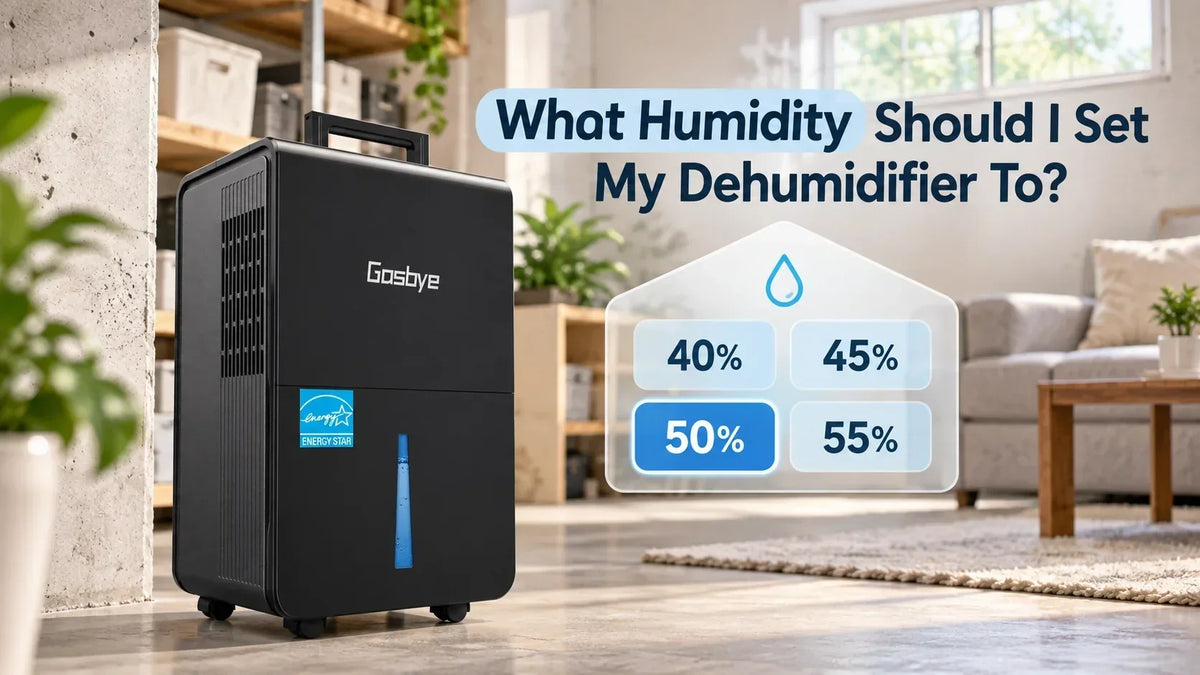
You turn on your dehumidifier and see several humidity settings: 40%, 45%, 50%, 55%.
Which one should you choose?
For most homes, 50% relative humidity (RH) is a practical place to start. If the room still feels damp or has signs of excess moisture, try lowering the setting to around 45%.
The right number can change depending on the room, the weather, and how much moisture is getting into the space. A basement may need a different approach than a bedroom, and setting the number lower isn't always better.
Here's how to find a setting that makes sense for your home.

Quick Answer: What Should I Set My Dehumidifier To?
Start at 50% RH.
The U.S. Environmental Protection Agency (EPA) recommends keeping indoor relative humidity below 60%, ideally between 30% and 50%. ENERGY STAR also says 30–50% is generally considered a good indoor range.
But that doesn't mean you should set your dehumidifier to 30%.
For most homes, 50% is a reasonable starting point. If the room still feels damp, smells musty, or shows other signs of excess moisture, try 45% and see if conditions improve.
Here's a simple way to think about the settings:
-
50% — Start here for most rooms.
-
45% — Try this if you need more moisture control.
-
40% — Usually lower than necessary as a default setting.
-
55% — May be workable in some spaces, but 50% is a better starting point when you can maintain it.
-
60% or higher — Generally too high as a normal target for a room you're trying to keep dry.
The goal isn't to reach the lowest number possible. It's to keep excess moisture under control without making the dehumidifier run more than necessary.
What Does the Humidity Setting on a Dehumidifier Mean?
The percentage on your dehumidifier is the humidity level you want the room to reach. It is not a power setting.
If you select 50%, you're telling the machine to keep the room around 50% relative humidity.
Most modern dehumidifiers have a built-in humidity sensor, often called a humidistat. It checks the moisture level in the air and helps the unit turn on and off as needed.
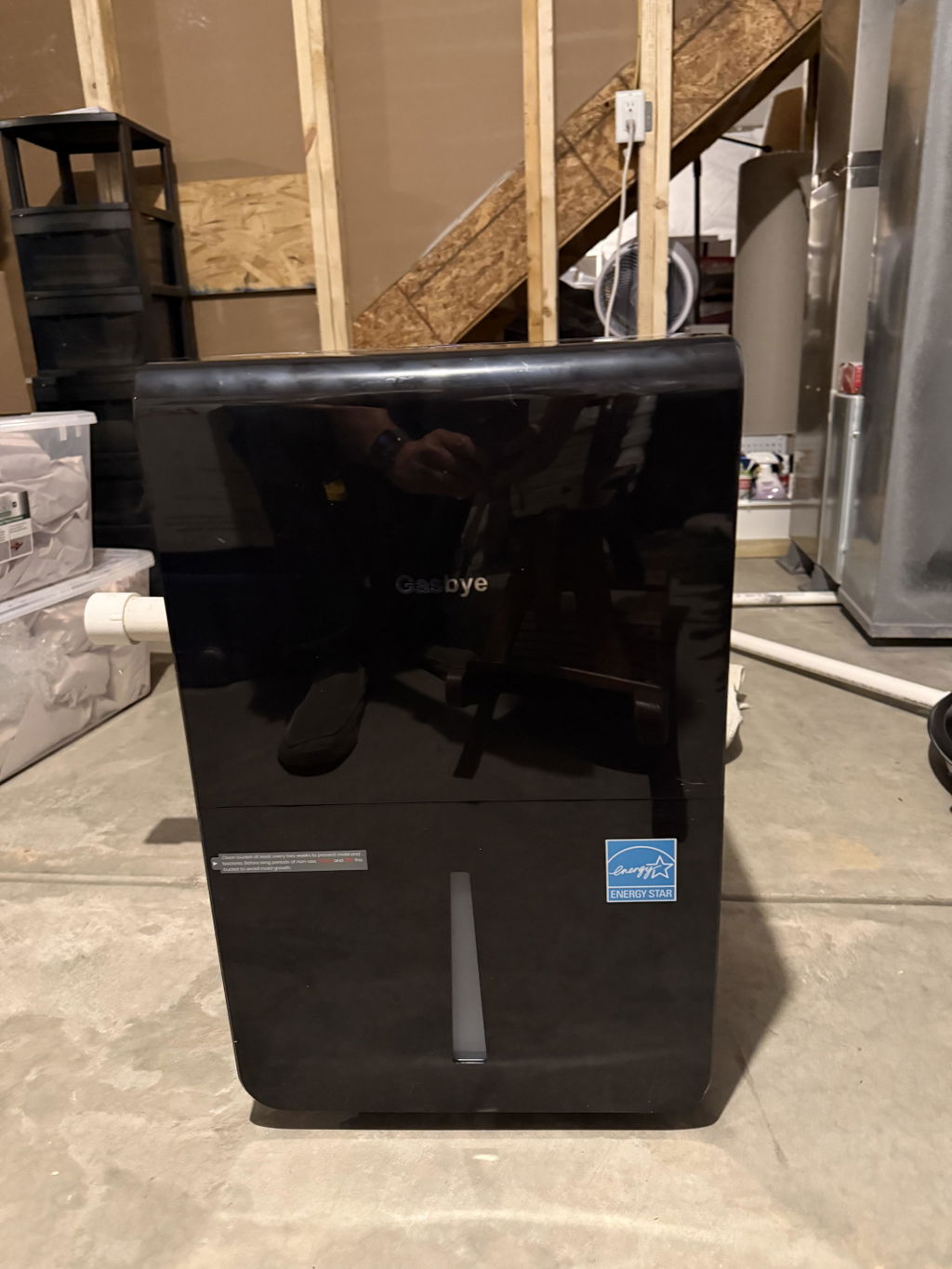
For example, Gasbye 115-pint dehumidifier lets you set your target humidity. Once the humidity drops below the setting, the compressor stops and restarts when the humidity rises again, so you don't have to manually turn the unit on and off.
So setting your dehumidifier to 40% doesn't mean it runs at “40% power.” It means you're asking it to bring the room's humidity down toward 40%.
That difference matters.
The lower you set the number, the more moisture the machine may have to remove. If your room is already comfortable around 48–50%, changing the setting to 40% may simply make the dehumidifier run longer without making the room noticeably more comfortable.
Should I Set My Dehumidifier to 40%, 45%, 50%, or 55%?
There isn't one perfect number for every home. Start with 50%, then adjust only if the conditions in the room give you a reason to.
50%: Start Here for Most Homes
If you're not sure what to choose, 50% RH is the simplest starting point.
It falls within the 30–50% range recommended by the EPA and gives your dehumidifier a useful target without immediately asking it to remove as much moisture as possible.
Set it to 50% and let the dehumidifier run for a while before deciding whether to change it.
If the room feels comfortable and you don't notice persistent dampness, condensation, or musty odors, you may not need to go any lower.
45%: Try This if the Room Still Feels Damp
If the room still feels damp around 50%, try 45% RH.
This can be useful in a humid basement or another space where moisture is harder to control.
But don't lower the setting just because 45% sounds better than 50%.
If the room is already dry and comfortable at 50%, lowering the target may only make the machine run longer.
40%: Usually Lower Than You Need
A 40% setting isn't necessarily wrong, but most homes don't need to start this low.
There are times when lower indoor humidity makes sense. For example, ENERGY STAR notes that homes in colder climates may need indoor humidity around 30–40% during the heating season to help prevent condensation on windows.
That doesn't mean everyone should set a dehumidifier to 40% in winter.
Many heated homes naturally become drier when the weather gets cold. If the humidity is already low enough, you may not need to run a dehumidifier at all.
55%: Possible, but Not the Best Starting Point
A room that stays around 50–55% RH isn't automatically a problem.
This is especially true in basements, where moisture can keep entering from humid outdoor air, the ground around the foundation, or other sources.
Still, if your dehumidifier can comfortably maintain 50%, that's a better place to start than deliberately setting it to 55%.
Also pay attention to what you see and smell. If the space has persistent musty odors, condensation, visible dampness, or water intrusion, don't assume everything is fine just because the display says 55%.
Is 60% Humidity Too High?
For a room you're trying to keep dry, 60% RH is generally higher than you want as a normal target.
The EPA recommends keeping indoor humidity below 60%, ideally between 30% and 50%.
A brief reading of 60% doesn't mean you suddenly have a mold problem. Humidity naturally rises and falls during the day.
But if a room regularly stays around or above 60%, it's worth finding out why.
Common reasons include:
-
Humid outdoor air entering through open doors or windows
-
Water leaks or seepage
-
Moisture entering through a basement or foundation
-
Poor airflow around the dehumidifier
-
A dehumidifier that can't keep up with the space
-
A cold room that makes moisture removal more difficult
If your basement humidity won't go below 60%, changing the setting may not solve the real problem.
A dehumidifier can remove moisture from the air. It can't repair a leak or stop water from entering through a foundation.
What Should I Set a Basement Dehumidifier To?
Start around 50% RH in a basement too.
You don't need to choose a much lower number just because the dehumidifier is downstairs.
Start at 50% and pay attention to both the humidity reading and how the basement actually feels.
If it still feels damp or smells musty, try 45%.
But if the dehumidifier runs for long periods and can't even get close to 50%, don't keep lowering the setting. Asking the machine to reach 40% won't help if it is already struggling to reach 50%.
Instead, look for the reason humidity remains high. There may be water entering the basement, humid air coming in from outside, poor airflow, or simply more moisture than the dehumidifier can remove.
Temperature matters too.
ENERGY STAR notes that when a room falls below about 65°F (18°C), frost can form on the coils of some dehumidifiers and reduce their performance. Some models are specifically designed to work at lower temperatures.
If you see ice on your unit or notice that it stops removing much water as the basement gets colder, read our guide to why a dehumidifier may stop collecting water or freeze up.
Should I Change My Dehumidifier Setting by Season?
Sometimes. But use the humidity inside your home, not the calendar, to decide.
During warm, humid weather, your dehumidifier may run frequently at a 45–50% setting because moisture keeps entering the room.
As fall arrives, outdoor temperatures may drop while a basement or another part of the home remains humid. There's no need to turn off the dehumidifier simply because summer is over.
Keep watching the humidity reading.
Later in the year, heated indoor air often becomes drier. If the room is already staying within a comfortable humidity range without the dehumidifier running, there's no reason to force it lower.
In other words, don't use a “summer setting” and a “winter setting” just because the season changed. Let the actual humidity in your home guide you.
Why Doesn't My Dehumidifier Match My Humidity Meter?
Don't worry if your dehumidifier says 50% while a separate humidity meter says 53% or 54%.
Humidity isn't exactly the same everywhere in a room.
Your dehumidifier measures the air near the machine. A separate meter across the room may be closer to a window, exterior wall, bathroom, air vent, or another area with slightly different conditions.
If you want to compare the two readings, place the humidity meter near the dehumidifier for a while and see if they move in the same direction.
For everyday use, a small difference of a few percentage points is usually less important than the overall pattern.
For example, if both readings fall steadily after the dehumidifier starts running, that's more useful than worrying about whether one says 48% and the other says 51%.
What If My Dehumidifier Never Reaches the Setting?
Suppose you set your dehumidifier to 50%, but the room stays around 58–62%.
Don't immediately change the setting to 40%.
A lower target doesn't make the dehumidifier more powerful.
First, check the simple things. Keep doors and windows closed while the machine is running. Make sure the filter is clean. Leave enough open space around the unit for air to move freely.
Then look for moisture entering the room.
A basement with water seepage, a bathroom used frequently, or a room exposed to humid outdoor air can gain moisture faster than a dehumidifier can remove it.
The dehumidifier may also be too small for the space, or the room may be too cold for the unit to work effectively.
If the humidity stays high no matter what number you select, the setting probably isn't the main problem.
The better question is: Why isn't the humidity coming down?
The Bottom Line
For most homes, 50% RH is a good place to start.
If the room still feels damp or shows signs of excess moisture, try 45%. Don't automatically choose 40% just because a lower number seems better.
Then watch what happens.
If 50% keeps the room comfortable and dry, leave it there. If your dehumidifier runs constantly but never reaches the setting, look for moisture sources, low room temperatures, blocked airflow, or a unit that may not be able to handle the space.
The best setting isn't the lowest number your dehumidifier allows.
It's the setting that keeps your space comfortably dry without making the machine work harder than it needs to.
FAQ
1. Is 50% a good setting for a dehumidifier?
Yes. For most homes, 50% RH is a practical starting point. It also falls within the EPA's recommended 30–50% indoor humidity range. If the room still feels damp, try lowering the setting to around 45%.
2. Should I set my dehumidifier to 40% or 50%?
Start with 50% unless you have a reason to go lower. If 50% keeps the room dry and comfortable, setting the machine to 40% may simply make it run longer.
3. Is 55% humidity too high for a basement?
Not necessarily. But if your dehumidifier can comfortably maintain 50%, that's a better starting target. Also watch for musty odors, condensation, visible dampness, or water entering the basement instead of relying on the humidity number alone.
4. Should a dehumidifier run all the time?
Not necessarily. Most units with humidity controls can cycle on and off once the room reaches the selected level. If yours runs almost constantly, the room may be very humid, the setting may be unnecessarily low, or the machine may be struggling to keep up.
5. When should I turn my dehumidifier off?
If the room stays within your desired humidity range without the dehumidifier running, you may not need it. This often happens as weather becomes cooler or indoor air becomes naturally drier. Check the actual humidity rather than turning the unit off just because the season changed.

Share:
Why Is My Room Still Humid With the Portable AC On? 7 Possible Reasons