
 Dehumidifiers
 Air Conditioners
 Vacuum Sealers
 Most people expect a portable air conditioner to feel noticeably cooler within 15 to 20 minutes. That's roughly what the box implies, and it's what most cooling guides repeat.
In humid climates — the Southeast, mid-Atlantic, Gulf Coast — it regularly takes two to three times longer. Not because the unit is broken, and not just because it's hotter outside. The reason is more specific than that, and once you understand it, the experience of your AC makes a lot more sense.
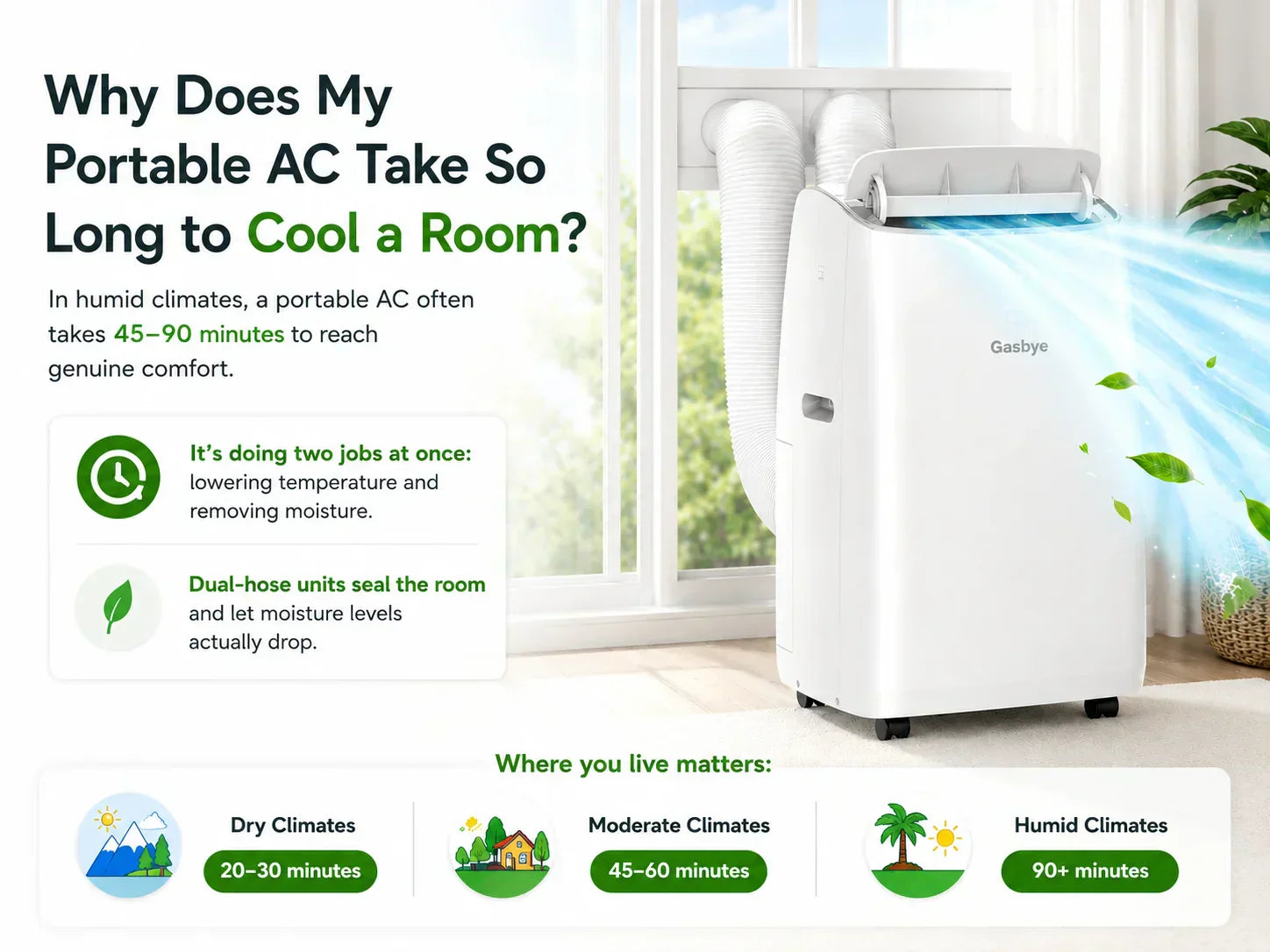
⏱ How long does it take?
- Dry climate, well-matched room — 20–30 minutes
- Moderate humidity — 30–45 minutes
- High humidity (Southeast, Gulf Coast) — 45–90 minutes
- Room too large for the unit — 60 minutes or more
These are estimates based on reaching genuine comfort — not just a drop on the thermometer. In humid climates, those two things don't move at the same speed.
The thermometer isn't telling you the whole story
This is the part most cooling guides skip entirely.
In humid air, temperature and comfort are not the same thing. The National Oceanic and Atmospheric Administration (NOAA) publishes a Heat Index chart that shows the gap: at 85°F with 40% humidity, it feels like 85°F. At 85°F with 70% humidity, it feels like 90°F. At 90°F with 70% humidity, it feels like 106°F.
That gap is what your AC is actually fighting.
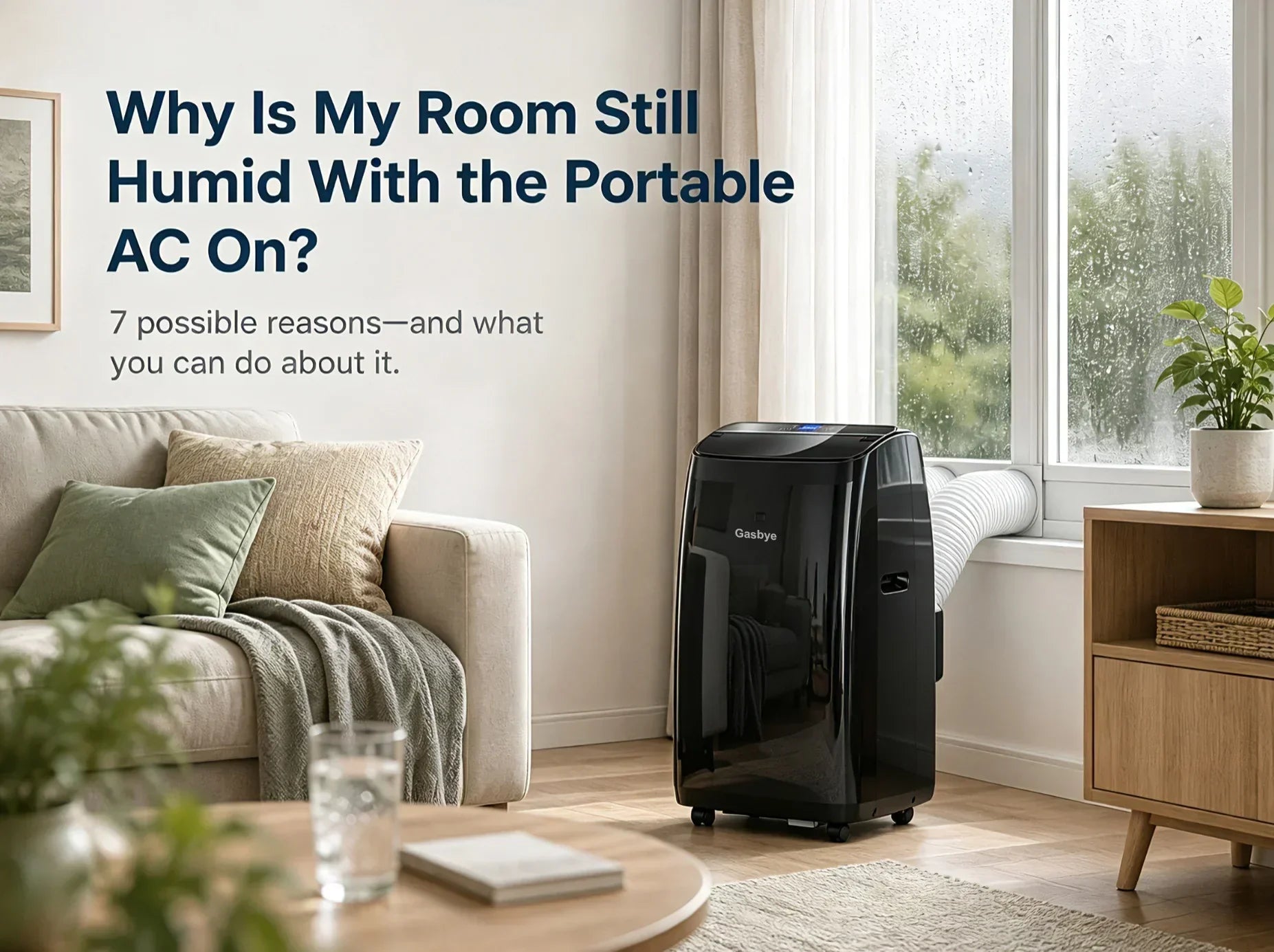
A portable AC does two things at once: it lowers temperature, and it removes moisture from the air. In dry climates, almost all of its energy goes toward lowering the temperature. In humid climates, a significant portion goes toward pulling moisture out of the air first — before the temperature even starts moving.
Here's what that means in practice. Say your AC runs for 30 minutes in a humid Virginia bedroom and the temperature drops from 88°F to 82°F. That's only 6°F on the thermometer. But if it also brought humidity down from 75% to 55%, the feels-like temperature dropped from around 97°F to around 85°F — a 12°F improvement in actual comfort, even though the thermometer barely moved.
The reverse is also true. If humidity stays high, a room can read 78°F and still feel like 88°F. This is why people in humid climates often say their AC "isn't working" when the thermometer shows it clearly is.
The thermometer is not the right measure. Comfort is. And in humid climates, comfort takes longer — not because the unit is slow, but because it has more to remove.
Why single-hose units fall further behind in humid climates
Most portable ACs sold in the U.S. use a single-hose design. The unit pushes hot air out through the hose — but to do that, it pulls air from inside the room. Every bit of air it sends outside gets replaced by air seeping back in through gaps around doors and windows.
In dry climates, that replacement air is hot but manageable. In humid climates, it's hot and moisture-heavy — which means the unit has to start the dehumidification process over again with every cycle of replacement air. The humidity in the room never fully comes down, so the feels-like temperature never fully comes down either.
This is why a single-hose unit in a Georgia summer can run for two hours, show 79°F on the thermostat, and still leave the room feeling sticky and uncomfortable. The temperature dropped. The humidity didn't.
For a detailed breakdown of this problem and how to check whether it's affecting your setup, see Portable AC Not Cooling Room? What's Actually Causing It.
What dual-hose changes
A dual-hose unit uses two separate hoses: one draws outside air in to cool the internal components, and the other pushes it back out. The air inside your room stays separate — cooled and recirculated without being used in the exhaust process.
That keeps the room sealed. The unit works with a fixed amount of air — fixed temperature, fixed moisture — until both come down to where they need to be. Once humidity drops, it stays down.
In testing, dual-hose units typically cool rooms 20–40% faster than single-hose units with similar power ratings. In dry climates, the difference is noticeable. In humid climates, it's more significant — because the sealed system is what allows the dehumidification to actually accumulate rather than reset with every breath of replacement air. For a deeper look at how dual-hose design works and when it still has limits, see Dual-Hose Portable AC: Why It Cools Faster — And When It Still Won't.
Other factors that slow things down
Floor level. Upper floors accumulate heat from below and from the sun hitting the roof directly. On a peak summer day, a top-floor bedroom can run 10–15°F hotter than the same size room on the ground floor. That's not a small difference — it's the equivalent of asking the AC to start from a meaningfully harder place.
West-facing windows. Direct afternoon sun pushes heat through glass continuously. A room with unshaded west-facing windows can absorb enough solar heat to add 8–10°F to the room temperature compared to a shaded room of the same size. Curtains or shades on those windows, closed before the heat builds (late morning is better than mid-afternoon), make a measurable difference.
Room size vs. unit size. Online calculators use square footage as their main input. They don't account for floor level, sun exposure, or the fact that portable ACs are inherently less efficient than window units. If your room gets afternoon sun, sits on an upper floor, or is in a humid region, add 20–25% to whatever size the calculator recommends.
What to expect by climate region
Dry climates (Colorado, Nevada, inland California, Arizona): 20–30 minutes to reach genuine comfort. This is closest to what the packaging implies. Humidity is rarely a significant factor.
Midwest and Northeast (Ohio, Pennsylvania, New York, New England): 25–45 minutes for most of summer. Humidity is moderate enough that the thermometer and comfort track fairly closely.
Mid-Atlantic and Carolinas (Virginia, Maryland, North Carolina, South Carolina): 35–60 minutes on hot, humid days. Summer humidity in this region regularly runs 65–75%, which pushes feels-like temperatures well above what the thermometer shows. Upper-floor rooms are especially slow to reach comfort.
Humid Southeast and Gulf Coast (Florida, Louisiana, Mississippi, Alabama, coastal Texas): 45–90 minutes during peak summer heat. This is where the gap between thermometer and comfort is widest — 90°F at 75% humidity feels like 109°F, and an AC has to pull a significant amount of moisture out of that air before the room starts to feel genuinely comfortable.
How to tell if your portable AC is cooling normally
Not every slow room is a sign of a problem. Use these as a rough benchmark:
Room drops 2–4°F in the first 15–20 minutes → Normal. In humid conditions, comfort may lag behind even as the temperature moves. Give it time.
Room cools initially, then stalls several degrees above where you want it → Usually a room size or sun exposure issue, not a malfunction. Check whether the room is larger than the unit is rated for, or whether afternoon sun is adding more heat than the unit can handle.
Unit runs for 90+ minutes with almost no change in temperature or comfort → Something is holding it back. The most common causes: the exhaust hose isn't sealed well at the window, the room is too large for the unit's rating, or — with single-hose units in humid climates — warm humid air keeps finding its way back in and the dehumidification never accumulates.
Air from the front vent doesn't feel noticeably cooler than the rest of the room → This points to a maintenance or setup issue. A clogged air filter, a kinked exhaust hose, or ice building up on the cooling coils inside the unit are the usual suspects.
For a full walkthrough of diagnosing these issues, see Portable AC Not Cooling Room? What's Actually Causing It.
Practical ways to reach comfort faster
Start before the hottest part of the day. Running the unit from around 1 PM, before afternoon heat peaks, is more effective than turning it on at 4 PM and trying to recover. In humid climates especially, getting ahead of both the heat and the moisture is far easier than catching up.
Add a ceiling fan. A ceiling fan doesn't lower room temperature, but it moves air across your skin, which makes a room feel 3–4°F cooler than it actually is. In humid conditions where the thermometer and comfort are already out of sync, this closes the gap faster than waiting for the AC to do everything alone.
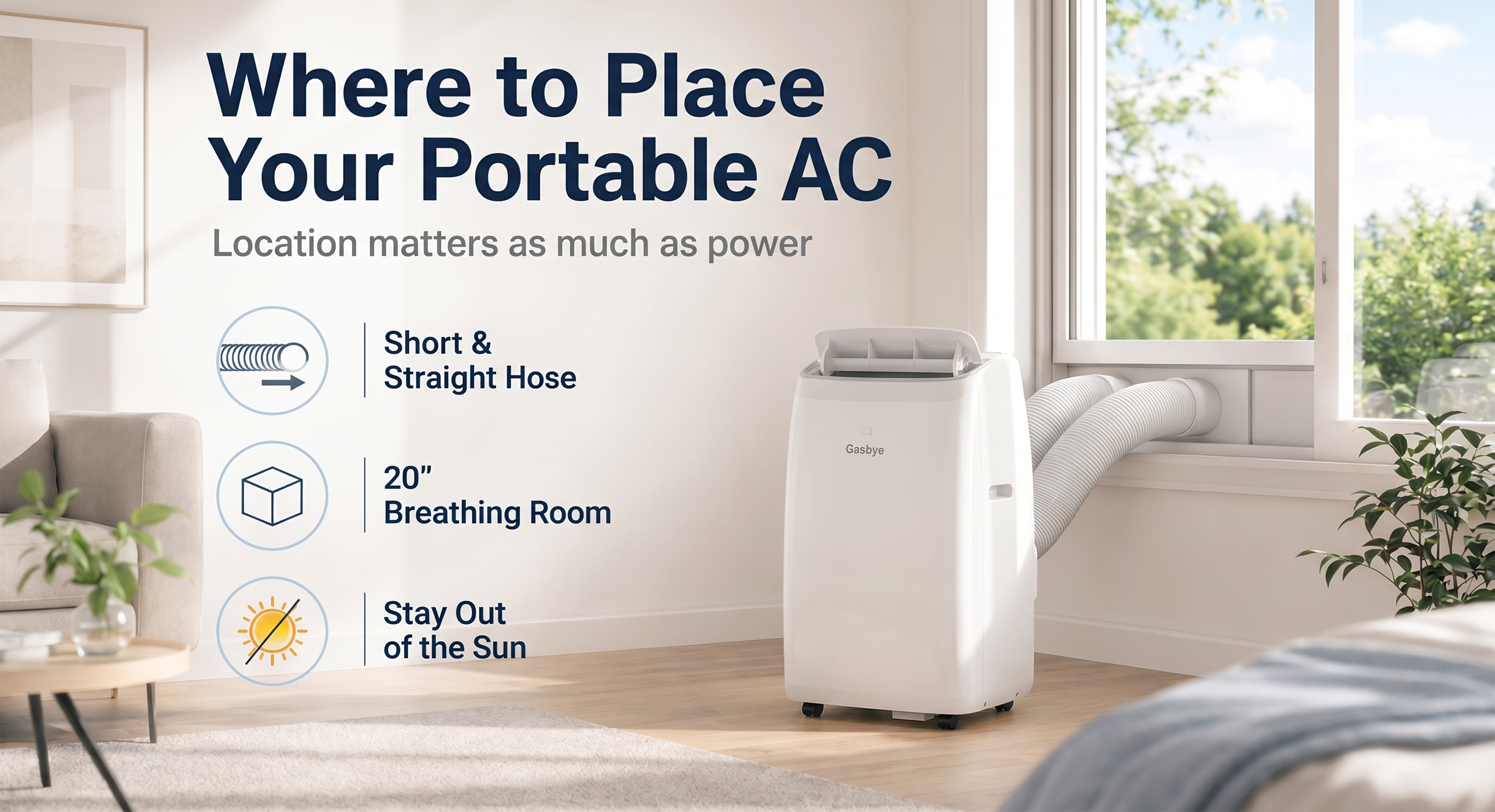
Reduce what the unit has to fight against. Blocking afternoon sun, sealing gaps around the window kit, and closing interior doors all meaningfully reduce how hard the unit has to work. Where you place the unit in the room also matters more than most people realize — see Where to Place a Portable AC for Maximum Cooling and Portable AC Not Cooling Room? What's Actually Causing It for a full checklist of both setup and environmental steps.
When an upgrade makes sense
If your unit runs for 90 minutes or more without reaching genuine comfort — not just a lower number on the thermometer, but a room that actually feels cool — the most common causes are an undersized unit, a poorly sealed installation, or a single-hose design that's continuously refilling the room with the humid air it's trying to remove.
Switching to a dual-hose unit with an inverter compressor addresses the last two. Unlike a standard compressor that cycles on and off, an inverter compressor adjusts its output continuously — running steadily during sustained afternoon heat rather than in short bursts, which holds both temperature and humidity more consistently over time.
If you're shopping for a replacement, two specs matter most: dual-hose configuration and inverter compression. In humid climates, these two features determine real-world performance more than BTU rating alone.
The CoolPrime 14,000 BTU and 15,000 BTU models are dual-hose inverter units built for rooms up to 500 and 550 sq. ft., with energy efficiency ratings of 13.6 and 13.0 CEER — where a higher number means lower electricity cost to run. If your current unit can't bring a room to genuine comfort through a humid afternoon, the difference in how these units handle the dehumidification side of cooling is where it shows most.

Share:
Where to Place a Portable AC for Maximum Cooling: The Ultimate Guide
How Loud Is 45 dB on a Portable AC?