
 Dehumidifiers
 Air Conditioners
 Vacuum Sealers
Portable AC Not Cooling Room: 3 Real Reasons
- The BTU number on the box overstates real output by up to 40%
- Single-hose designs create negative pressure that pulls hot air back into the room as fast as the unit cools it.
- Most rooms have a higher heat load than square footage alone suggests.
The short answer: your AC is probably fighting harder than it needs to — and losing.
Most people assume a portable AC that's "on" is an AC that's working. But running and effectively cooling are two different things. There are three core reasons portable ACs fall short, and once you understand them, the fix becomes obvious.

1. The BTU number on the box isn't the number you think it is
BTU (British Thermal Unit) measures cooling power. A higher number means more cooling capacity. Simple enough — except the number on most product listings is measured under the old ASHRAE standard, which tests units in near-ideal lab conditions.
Since 2017, the US Department of Energy (DOE) requires a different, stricter measurement called the SACC (Seasonally Adjusted Cooling Capacity). Under real-world conditions, the same unit that's labeled "14,000 BTU" might only deliver around 9,000–10,000 BTU of actual cooling.
That's not a rounding error. That's a 30–40% gap between what you think you're getting and what you actually get.
What this means for you: If you sized your unit based on the big number on the box, your room is almost certainly undersized for cooling. A unit marketed as covering 700 sq ft might realistically only handle 450–500 sq ft on a hot day.
This is why comparing units based on ASHRAE BTU alone is misleading. SACC gives a much closer estimate of how the unit will perform in real conditions, especially over long periods of use.
2. Single-hose ACs pull hot air in through your walls
This is the biggest design flaw that most people never find out about until they've already bought.
Here's how it works. A single-hose portable AC takes air from inside your room, uses it to cool the refrigerant coils, then exhausts that hot air outside through a hose. That sounds fine — until you realize it's constantly removing air from your room.
That creates negative air pressure. Your room becomes slightly lower pressure than the surrounding spaces. So air rushes in to fill the gap — through door gaps, window cracks, and any other opening it can find. And where is that air coming from? The hallway, the attic, outside. All of it warmer than the air you just exhausted.
In mild conditions, 25°C (77°F) outside, sealed room, low humidity — you might not notice. But on a 35°C (95°F) day in July with humidity above 60%, your single-hose AC is in a constant tug-of-war with physics. It cools, creates a vacuum, pulls hot air in, cools again, creates a vacuum again. The room temperature creeps down slowly — or doesn't come down at all.
A dual-hose unit solves this completely. It uses one hose to bring outside air in for cooling the coils and a separate hose to exhaust it back out. Room pressure stays neutral. No hot air infiltration. The unit cools the room and only the room.
When evaluating a portable AC, this design detail matters more than the headline BTU number. Many underperforming units aren’t failing because they’re broken — they’re working against their own airflow design.
In humid climates — Florida, Texas, Louisiana, Georgia, the Gulf Coast generally — the difference between single-hose and dual-hose isn't a minor upgrade. It's the difference between an AC that works and one that doesn't.
If you want to understand why dual-hose units cool faster — and when they still won’t be enough — read our guide here.
3. You're underestimating your room's heat load
BTU calculators online ask for your room's square footage. That's a starting point, but it misses several factors that dramatically increase how hard your AC has to work:
- Sun exposure: A west-facing room in Arizona at 4pm in July is absorbing a significant amount of radiant heat through the walls and windows. A north-facing basement room of the same size is a completely different environment.
- Floor level: Upper floors and attics accumulate heat. A room on the top floor of a house can be 5–8°C (9–14°F) hotter than the same square footage on the ground floor.
- Humidity: Humid air feels hotter. At 32°C (90°F) with 70% humidity, the feels-like temperature is closer to 41°C (106°F). Your AC has to work to remove both heat and moisture simultaneously.
- Number of people and electronics: A home office with two monitors, a laptop, and a person generates meaningful heat continuously.
Rule of thumb: If your room gets direct afternoon sun, is on an upper floor, or you live in a humid region, add at least 20–25% to whatever BTU number the calculator gives you.
Why Is My AC Not Keeping Up in Summer — Even When It Was Fine in Spring?
The answer: summer isn't just hotter, it's a different operating environment entirely.
A portable AC that handled your room fine in May at 28°C (82°F) can completely lose the battle in July at 38°C (100°F). This isn't a malfunction. It's physics.
Air conditioners work by moving heat from inside to outside. The bigger the temperature gap between inside and outside, the harder that heat transfer becomes. When it's 38°C (100°F) outside and you want 22°C (72°F) inside, you're asking the unit to create a 16°C (29°F) differential. When it was 28°C (82°F) outside in spring, that gap was only 6°C (11°F).
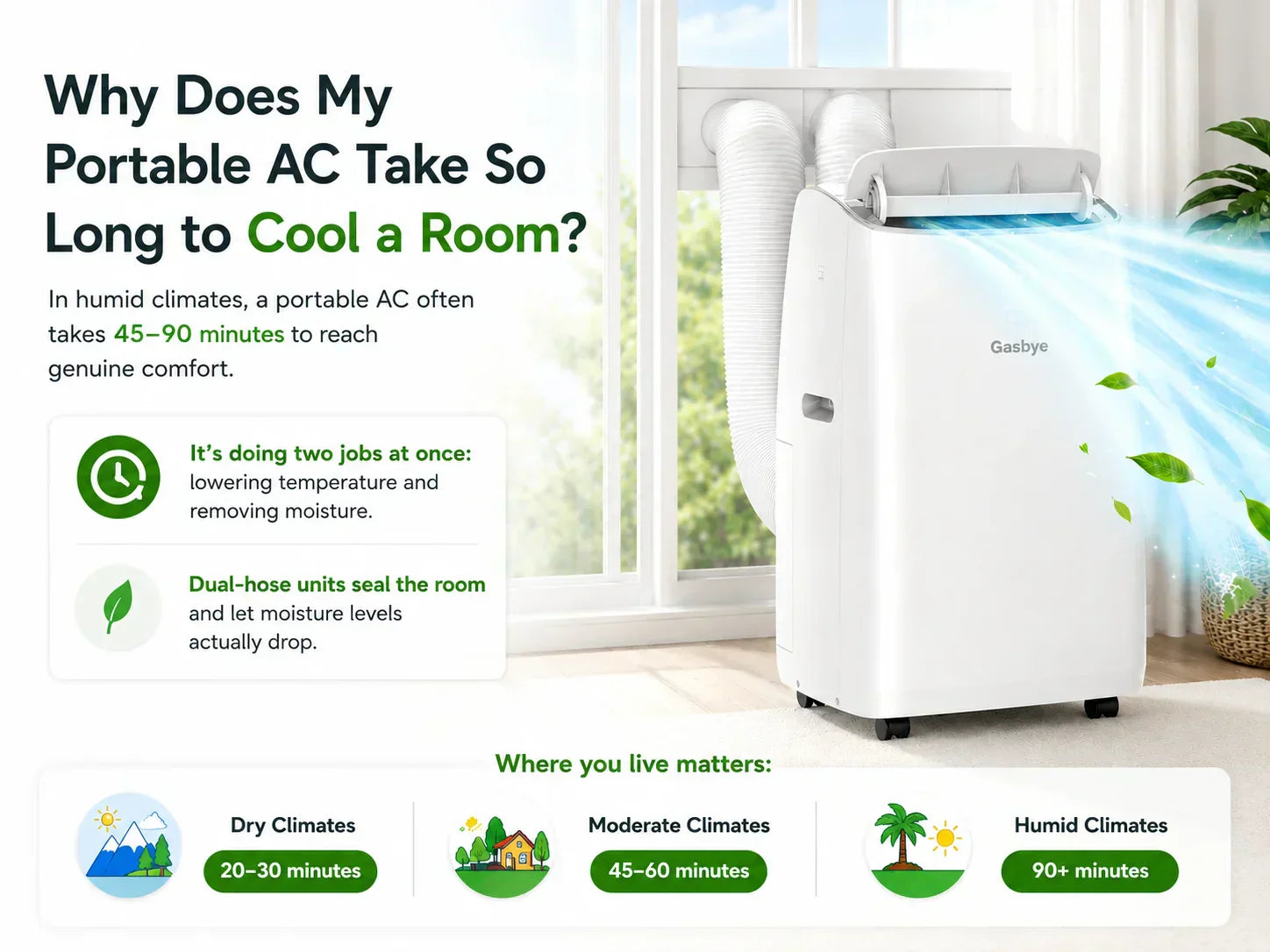
Add humidity to that equation and things compound quickly. Humid air requires the AC to run the dehumidification cycle more aggressively, which consumes capacity that would otherwise go toward cooling. This is why a unit that seems adequate in dry climates (Nevada, New Mexico, Colorado) genuinely struggles in humid ones (Florida, the Southeast, the Mid-Atlantic in August).
The regional reality:
- Phoenix, Las Vegas, Tucson: Extreme heat (up to 45°C / 113°F), but low humidity. Single-hose struggles due to sheer heat load. BTU sizing is critical. Dual-hose helps efficiency.
- Houston, Miami, New Orleans: High heat combined with 70–90% humidity in peak summer. This is where single-hose ACs fail most dramatically. Dual-hose systems tend to perform far more reliably under these conditions.
- New York, Chicago, Philadelphia: Moderate heat (32–36°C / 90–97°F) with periodic high humidity. Single-hose can get by in well-sealed, shaded rooms. Dual-hose will always outperform.
- Denver, Salt Lake City, Albuquerque: Dry heat. Lower humidity means single-hose performs better than in the South, but BTU adequacy still matters.
What Is the 3 Minute Rule for Air Conditioners?
The 3 minute rule: after turning off your AC, wait at least 3 minutes before turning it back on.
If power is cut and immediately restored, the compressor tries to restart against its own residual pressure. This causes strain on the motor and, over time, shortens the compressor's life significantly. Some modern units have built-in delay protection. Many don't.
The practical implication: don't cycle your AC on and off frequently in an attempt to cool the room faster. It doesn't work and it damages the unit.
If your room gets uncomfortably hot while the AC is off, the real fix is addressing the heat sources — not cycling the unit more aggressively.
How to Help Your AC on Hot Days (Without Buying Anything New)
The short answer: reduce what your AC has to fight against.
Your AC doesn't cool your room in isolation. It's competing against every source of heat in and around that room. The more you can reduce that competition, the better your existing unit will perform.
Block radiant heat before it enters
Up to 30% of the heat in a room on a sunny day comes through windows as radiant solar energy. Blackout curtains or cellular shades on south and west-facing windows make a measurable difference. Closing them before the room heats up (mid-morning) is more effective than closing them after it's already hot.
Seal the exhaust hose connection properly
The foam window kit that comes with most portable ACs is a starting point, not a finished seal. Hot outside air leaks around it constantly. Use foam weatherstripping tape to seal any gaps around the window bracket. This is free, takes ten minutes, and some users report a noticeable improvement in cooling effectiveness.
Check that the exhaust hose isn't kinked or too long
Most hoses are 5–6 feet when extended. The shorter and straighter the hose, the less heat radiates back into the room and the better the airflow. A kinked or overly extended hose creates back pressure that reduces efficiency.
Give the unit enough breathing room
Portable ACs pull air in from the back or sides. If the unit is pushed against a wall or hemmed in by furniture, it's restricting its own intake before the air even reaches the coils. Leave at least 20 inches (50 cm) of clearance on all intake sides. A unit that can breathe freely will always outperform the same unit crammed into a corner.
Minimize heat sources in the room
Cooking, running a dryer, leaving electronics on standby — all of these add heat load. On the hottest days, the difference between a room with two monitors running versus one can be meaningful.
Pre-cool the room before peak heat
Run the AC in the morning when outside temperatures are lower (and the unit runs more efficiently) to bring the room down to a comfortable temperature. It's much easier to maintain a cool room than to cool down a hot one at 3pm.
How to Prepare Your AC for Summer
The honest answer: preparation matters more for performance than most people expect.
Before the heat arrives, run through this checklist:
Clean or replace the filter. A clogged filter restricts airflow and forces the unit to work harder for less output. Most portable ACs have a washable filter behind a panel. Rinse it, let it dry fully, and replace it. Do this at the start of the season and every 2–3 weeks during heavy use.
Inspect the exhaust hose for damage. Cracks or holes in the exhaust hose mean hot air is leaking back into your room. Hold the hose up to the light and look for any gaps. Replace if needed — most hoses are inexpensive and universal.
Check the drainage situation. In humid climates, portable ACs collect condensate. Most modern units have auto-evaporation, but in very humid conditions you may need to empty a tank or connect a drain hose. If you ignore this, some units will shut off automatically when the tank fills — and you won't know why your AC stopped cooling.
Test it before you need it. Run the unit on a mild day and verify it's cooling properly, the exhaust is sealed, and the controls work. Finding a problem in April is much better than finding it on the first 38°C (100°F) day of July.
Reassess your setup honestly. If your unit struggled last summer, it will struggle again this summer under the same conditions. The question to ask: is the problem fixable (sealing, sizing, cleaning) or structural (single-hose in a humid climate, undersized BTU for the actual room)?
What to Look for in a Portable AC That Actually Works
If you're trying to avoid the common performance issues above, a few design factors make a disproportionate difference:
- Dual-hose airflow design (prevents negative pressure)
- SACC rating instead of relying on ASHRAE BTU alone
- Inverter-driven compressor for stable output under changing heat load
- Proper sizing based on real conditions, not just square footage
These factors don’t guarantee performance on their own, but missing any one of them is often where problems start.
Gasbye's CoolPrime series is built around all four: dual-hose design, verified SACC ratings, full DC inverter compressor, and honest BTU labeling. Available in 14,000 BTU and 15,000 BTU.
The Bottom Line
Before you blame the unit, run through three questions:
1. Is the BTU rating based on SACC or the old ASHRAE standard? If it's ASHRAE, the real output is likely 30–40% lower than advertised.
2. Is it single-hose or dual-hose? In any climate above 32°C (90°F), or anywhere humidity regularly exceeds 60%, single-hose is fighting a losing battle by design.
3. Have you addressed the room itself? Sealing the exhaust hose, blocking afternoon sun, and pre-cooling in the morning cost nothing and make a real difference.
If the answer to all three still points to a unit that's genuinely undersized or structurally limited for your climate, that's useful information too — better to know before another summer goes by.
Share:
How to Choose the Best Vacuum Sealer Bags for Your Machine
Dual-Hose Portable AC: Why It Cools Faster — And When It Still Won't
1 comment
Learning this is a great help for homeowners. It will help us identify whether a portable AC is right for us.