
Humidity isn’t just uncomfortable—it can affect your health, your home, and your daily life. Dust mites, mold, and bacteria thrive when indoor relative humidity exceeds 50%, while excess moisture can damage furniture, warp wood, and leave rooms feeling musty. Choosing the right dehumidifier isn’t about picking the most expensive model—it’s about understanding capacity, technology, placement, and maintenance. Here’s a practical, step-by-step guide you can follow.
1. Why Controlling Humidity Matters
-
Health: Humidity above 50% encourages dust mites and mold, common triggers for allergies and respiratory issues.
-
Comfort: Dry air feels cooler, reduces sticky surfaces, and improves sleep quality.
-
Home & Belongings: High humidity can warp wood, damage electronics, and leave fabrics musty.
Tip: Keep indoor humidity between 40–50%. A simple hygrometer will help you track changes, especially during summer or rainy seasons.
2. Matching Capacity to Your Room
Not all “pints per day” are equal—capacity depends on temperature, humidity, and unit design.
-
Small spaces (<300 sq ft) – bathrooms, closets, RVs
-
Recommended capacity: 20–25 pints/day
-
Notes: Suitable for occasional moisture and minor dampness
-
-
Medium spaces (300–500 sq ft) – bedrooms, home offices
-
Recommended capacity: 30–35 pints/day
-
Notes: Provides consistent humidity control for everyday comfort
-
-
Large spaces (500–1500+ sq ft) – basements, living rooms, garages
-
Recommended capacity: 50+ pints/day
-
Notes: Ideal for high humidity areas and frequent moisture buildup
-
Pro insight: Some brands inflate their numbers by testing at extreme conditions (e.g., 95°F, 90% RH). Gasbye units list capacity under realistic conditions—you can expect the rated performance in everyday use.
Weight matters: A heavier unit often has more copper inside, meaning better dehumidifying power and energy efficiency. Lightweight units with high “pint” claims may underperform in real-world conditions.
3. Understanding Technology: Compressor vs. Semiconductor
-
Compressor dehumidifiers (300–500W): Efficient, quick, ideal for medium-to-large spaces like basements or garages. Noise is around 45dB—quiet enough for watching TV or working.
-
Semiconductor units (60–100W): Low energy draw, but effective only in small rooms. Multiple units may be needed for a space over 300 sq ft, negating energy savings.
Tip: For large spaces, compressor models are typically more practical and cost-efficient. For closets or cabinets, semiconductor units may suffice.
4. Pump or Non-Pump? Choosing the Right Drainage
Non-pump units: Gravity-based, hose must run downward, max length usually ≤5 ft.
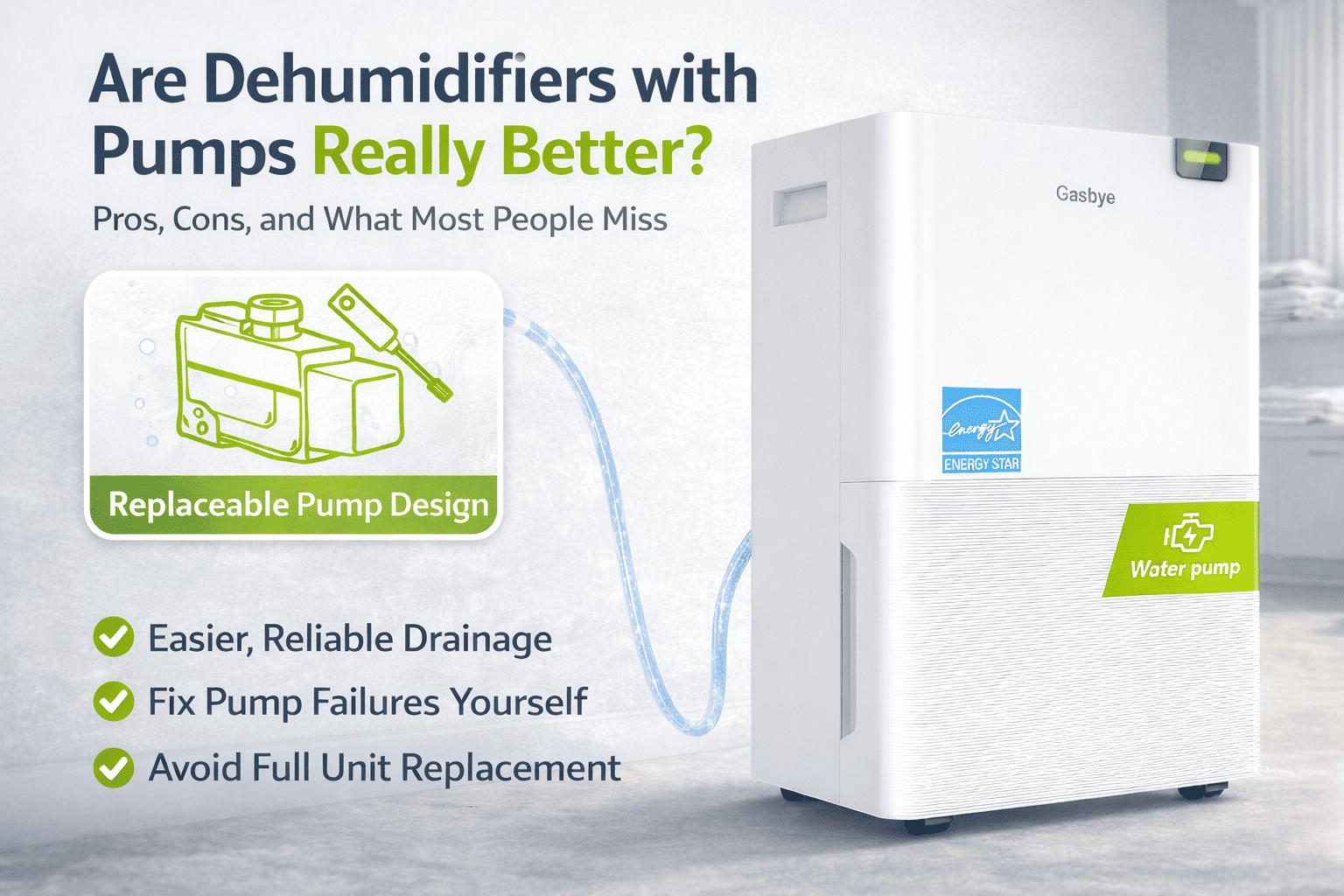
Pump-equipped units: Can push water up to 16 ft or over obstacles, ideal for basements or tricky placements.
Maintenance tip: Pumps that can’t be cleaned often fail after 1–2 years due to dust and residue buildup. Gasbye’s DryPrime-35-BP has a pump inside the water tank, easy to clean and replace, extending its lifespan.
Practical tip: If your basement floor is lower than your drain point, choose a pump-equipped unit. It saves time and hassle.
5. Corrosion Resistance
Moist environments accelerate rust and shorten lifespan.
-
Look for graded anti-corrosion protection, especially for basement or high-humidity use.
-
Materials like stainless steel or epoxy-coated metals last longer.
Gasbye applies different anti-corrosion levels based on unit positioning, ensuring durability and performance over the years.
6. Warm Air and Energy Considerations
Some people worry that dehumidifiers make rooms warmer and increase AC costs.
-
Dehumidifiers emit warm air as they extract moisture, similar to small AC units.
-
Slight warmth reduces the AC’s dehumidification load, often lowering overall energy bills.
-
Stronger dehumidifiers emit more warm air, indicating higher capacity—not higher energy consumption.
Tip: Don’t equate less warm air with better efficiency. A small unit emitting little heat may simply have lower performance.
7. Placement and Installation
-
Keep at least 6 inches from walls for airflow.
-
Avoid corners or enclosed spaces with stagnant air.
-
Use pump-equipped units for basements with low drains; ensure hose slope or vertical lift matches specifications.
-
Consider portable units with wheels for multi-room flexibility.
Example: In a 600 sq ft basement, placing a 50-pint compressor unit near the center and routing the pump hose to a floor drain ensures quick, uniform dehumidification.
8. Maintenance Checklist
-
Filters: wash or replace monthly during peak humidity.
-
Tanks: check or empty weekly if not using continuous drainage.
-
Coils and vents: clean to prevent dust buildup and maintain efficiency.
-
Hoses: inspect for cracks if using a pump.
-
Schedule seasonal inspections, especially in spring and summer.
9. Common Misconceptions
-
Lightweight units are better. True dehumidifying power comes from internal components, not just weight.
-
Less warm air is better. Low heat often signals lower capacity.
-
Semiconductor units save more energy. Low wattage doesn’t guarantee efficiency—many are ineffective in large spaces.
10. Quick Decision Checklist
-
Measure your room size and humidity levels.
-
Choose capacity based on real-world conditions.
-
Decide pump vs. non-pump based on drainage needs.
-
Check corrosion protection and build quality.
-
Confirm features: humidistat, auto shut-off, quiet operation, energy efficiency.
-
Plan regular maintenance.
Conclusion
A well-chosen dehumidifier does more than remove moisture—it protects your health, your home, and your comfort. By understanding capacity, technology, pump options, and maintenance, you can confidently pick a unit that works efficiently, keeps humidity below 50%, reduces allergens, and lasts for years.


Share:
Stay Cool During Late Summer: How a Dual-Hose Portable AC Can Keep Your Home Comfortable
Fall Humidity Problems: Why Autumn Air Isn’t As Dry As You Think