
 Dehumidifiers
 Air Conditioners
 Vacuum Sealers
The Quick Answer
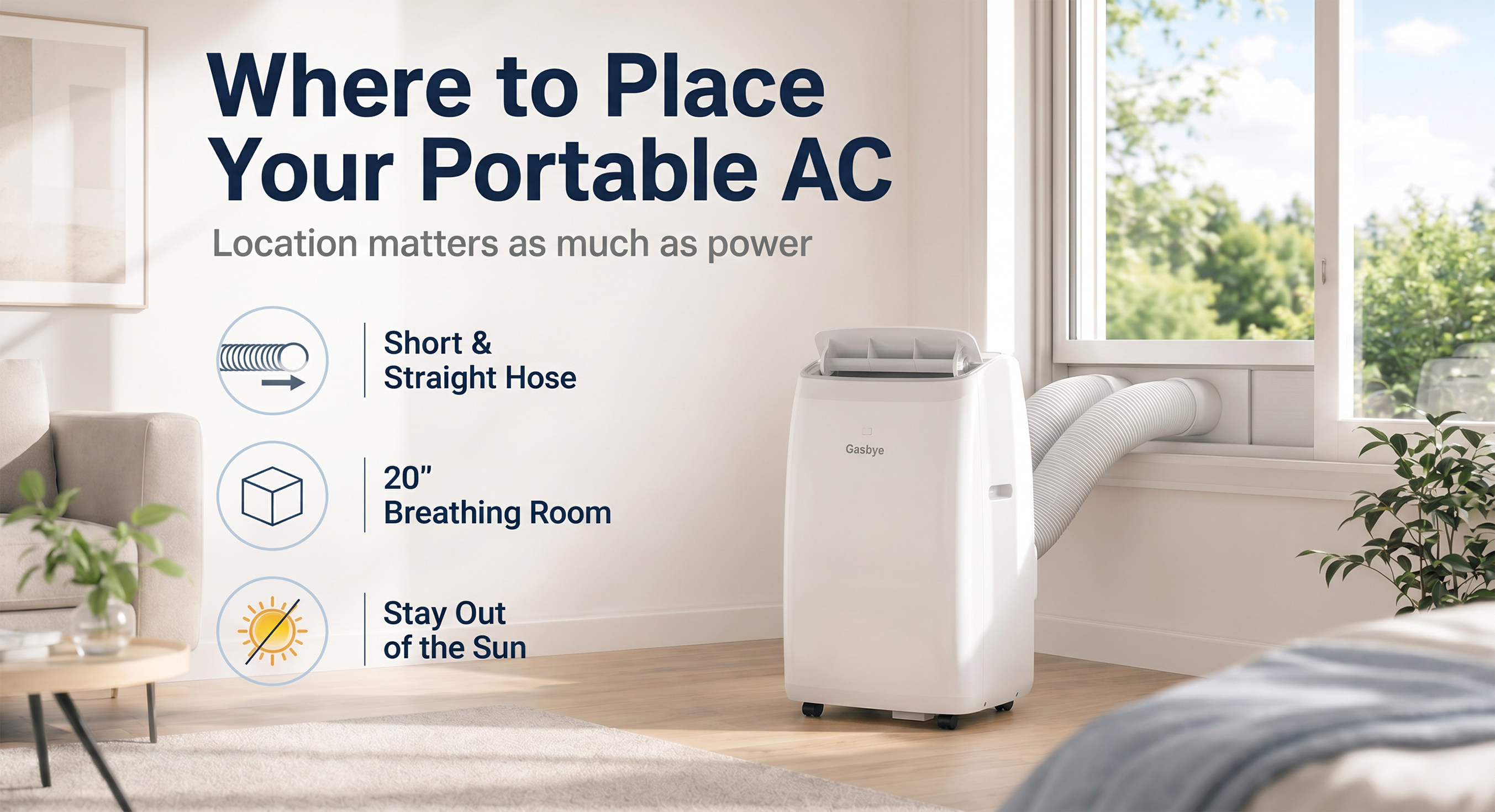
Where is the best place to put a portable AC? For maximum cooling, place your unit in a shaded area near a window, ensuring the exhaust hose is kept short and straight. Maintain at least 20 inches of clearance from walls or furniture to allow the vents to breathe. For large or rectangular rooms, position the AC along the longest wall to help the cold air circulate further across the space.
1. Why Your AC’s Location Matters as Much as Its Power
Many people believe that as long as they buy a powerful unit, they can tuck it away in a corner and stay cool. Unfortunately, it doesn't work that way. If you hide a 15,000 BTU unit behind a dresser or in a tight closet, it will only cool the small pocket of air around itself, while you stay hot on the sofa.
The logic is simple: A portable AC works by blowing cold air into the room while pumping hot air out through a hose. If the placement is wrong, that heat will sneak back in, or the cold air will never reach you.
2. The Golden Rules of Placement
Rule #1: The "Short & Straight" Hose
Think of your exhaust hose as a warm radiator. The longer the hose is stretched, the more heat it leaks back into your room.
-
The Tip: Keep the unit as close to the window as possible. Avoid sharp bends or kinks in the hose; the smoother the airflow, the less energy your AC wastes.
Rule #2: Give it "Breathing Room"
Your AC needs to pull in air to cool it down. If you block the back of the unit by pushing it against a wall or hiding it behind a couch, it will struggle to breathe and might even overheat.
-
The Tip: Keep a 20-inch (approx. 2 feet) perimeter of space around the machine.
Rule #3: Stay Out of the Sun
If direct sunlight hits the AC unit, its internal sensors will think the room is much hotter than it actually is. This causes the compressor to work overtime, leading to higher electricity bills.
-
The Tip: Place the unit on the shaded side of the room whenever possible.
3. Common Placement Mistakes That Kill Your Cooling
Even a well-placed unit can underperform if you're making one of these mistakes.
Mistake #1: Kinking or Extending the Hose
A bent hose restricts airflow and forces the compressor to work harder. An extended hose radiates heat back into the room before it ever reaches the window. Keep the hose as short and straight as possible — if it won't reach, move the unit, not the hose.
If your window is higher than the unit's exhaust port, raising the unit on a stable surface lets the hose run straight and level, rather than angling upward and restricting airflow. For example:
Mistake #2: Poor Window Sealing
If warm air can squeeze back in around the window kit, your AC is fighting a losing battle. Check for gaps between the panel and the window frame and seal them with foam tape or a towel. It takes two minutes and makes a noticeable difference.
Mistake #3: Running It in a Closed-Off Alcove
Tucking the unit into a recessed corner or against three walls blocks the intake and traps heat around the machine. Even if the hose reaches the window, the unit itself needs some open space around it to breathe.
Mistake #4: A Clogged Air Filter
A dirty filter forces the unit to pull harder for less airflow. Most portable ACs have a washable filter that takes under five minutes to clean. If your unit isn't cooling as well as it used to, this is the first thing to check.
Mistake #5: Leaving Doors and Windows Open
This one seems obvious, but it's easy to forget when kids are coming and going. Every time a door opens, warm air rushes in, and your AC has to start over. Keep the space as sealed as possible while the unit is running.
4. Why Dual-Hose Units Cool Better
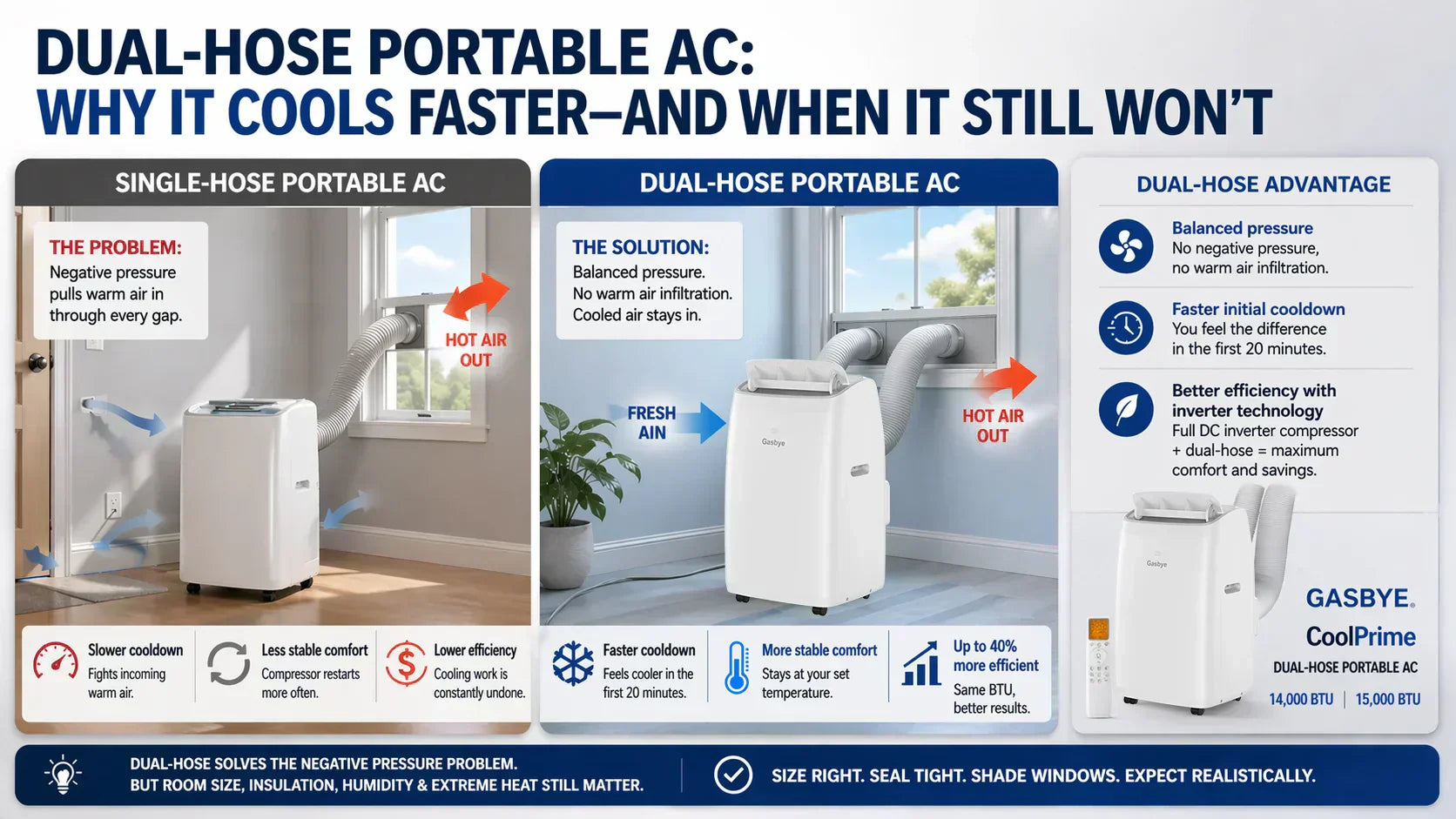
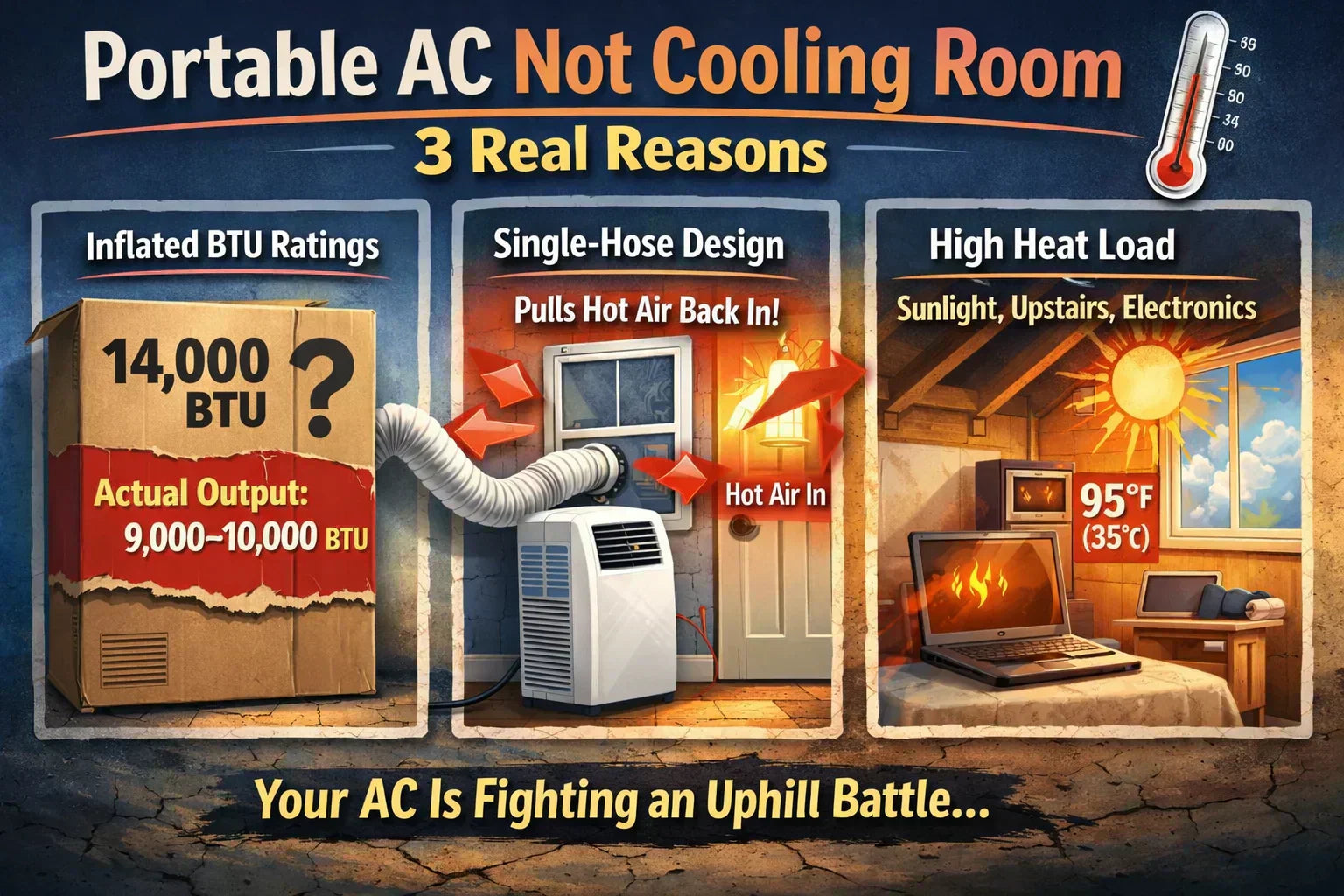
Standard single-hose portable ACs have a hidden problem: as they push hot air outside, they create a slight vacuum inside the room. This pulls warm air back in through door gaps, window cracks, and other openings — quietly working against the cooling you're paying for.
Dual-hose units solve this. One hose draws outside air in to cool the compressor; the other pushes the heat back out. Your indoor air stays where it belongs, and all the cooling power goes toward lowering the room temperature.
This is especially noticeable in larger spaces. Our Gasbye 14,000 BTU or 15,000 BTU Dual-Hose is built for rooms where a single-hose unit would struggle to keep up — open-concept living areas, large primary bedrooms, or any room that tends to hold heat.
If you're cooling a smaller space, our Gasbye 12,000 model uses the same dual-hose design and is sized for bedrooms and home offices where you want efficient, focused cooling without oversizing.
5. Placement Tips by Room
-
The Master Bedroom: Don't point the AC directly at your head. Place it near the window and angle the louvers toward the foot of the bed. This lets cool air circulate through the room gradually without blasting you directly.
-
The Home Office: Computers and monitors generate significant heat. Place the AC on the opposite side of your desk so the cold air flows past your equipment and draws the warmth toward the intake vent, rather than letting heat pool around your workspace.
-
The Living Room: For long or open-plan spaces, position the unit along the longest wall. The Gasbye 15,000 BTU is strong enough to push cool air across a full living area, reaching the dining nook or connecting rooms that smaller units can't touch.
FAQs
Q: Can I buy an extension to make the exhaust hose reach a far window?
A: We don't recommend it. Longer hoses radiate more heat back into the room and reduce efficiency. Moving the unit closer to the window is always the better fix.
Q: Why is my room still warm at the far end?
A: Air circulation is likely blocked or insufficient. Try placing a small floor fan opposite the AC to push cool air into stubborn hot spots.
Q: Is it okay to put a portable AC on a carpet?
A: Yes, as long as the carpet isn't thick enough to block the intake vents at the base of the unit. If airflow feels restricted, a thin, hard mat underneath will do the trick.
Q: Is a Dual-Hose unit harder to install?
A: Not at all. The Gasbye kit includes everything you need for a standard window. Snapping the hoses into the window bracket takes just a few minutes.
Conclusion
Smart placement can make a bigger difference than raw BTU power. Keep the hose short, give the unit room to breathe, and match the model to your room size — and you'll get the most out of whichever Gasbye unit you choose.
Ready to upgrade your comfort? Check out our Gasbye Dual Hose Portable AC lineup and see why it’s the top choice for high-performance cooling.

Share:
Dual-Hose Portable AC: Why It Cools Faster — And When It Still Won't