
 Dehumidifiers
 Air Conditioners
 Vacuum Sealers
If you've ever run a portable AC for an hour and wondered why the room still feels warm, the problem probably isn't the machine's fault. It's the design.
Most portable ACs use a single hose. A small number use two. That difference in plumbing changes how the unit interacts with your room — and understanding it will tell you whether a dual-hose unit will actually solve your problem, or whether something else is getting in the way.

The problem with single-hose portable ACs
A single-hose portable AC pulls air from inside your room, runs it over the condenser to cool the compressor, then blows that heated air outside through the hose.
That sounds reasonable. The issue is what happens next.
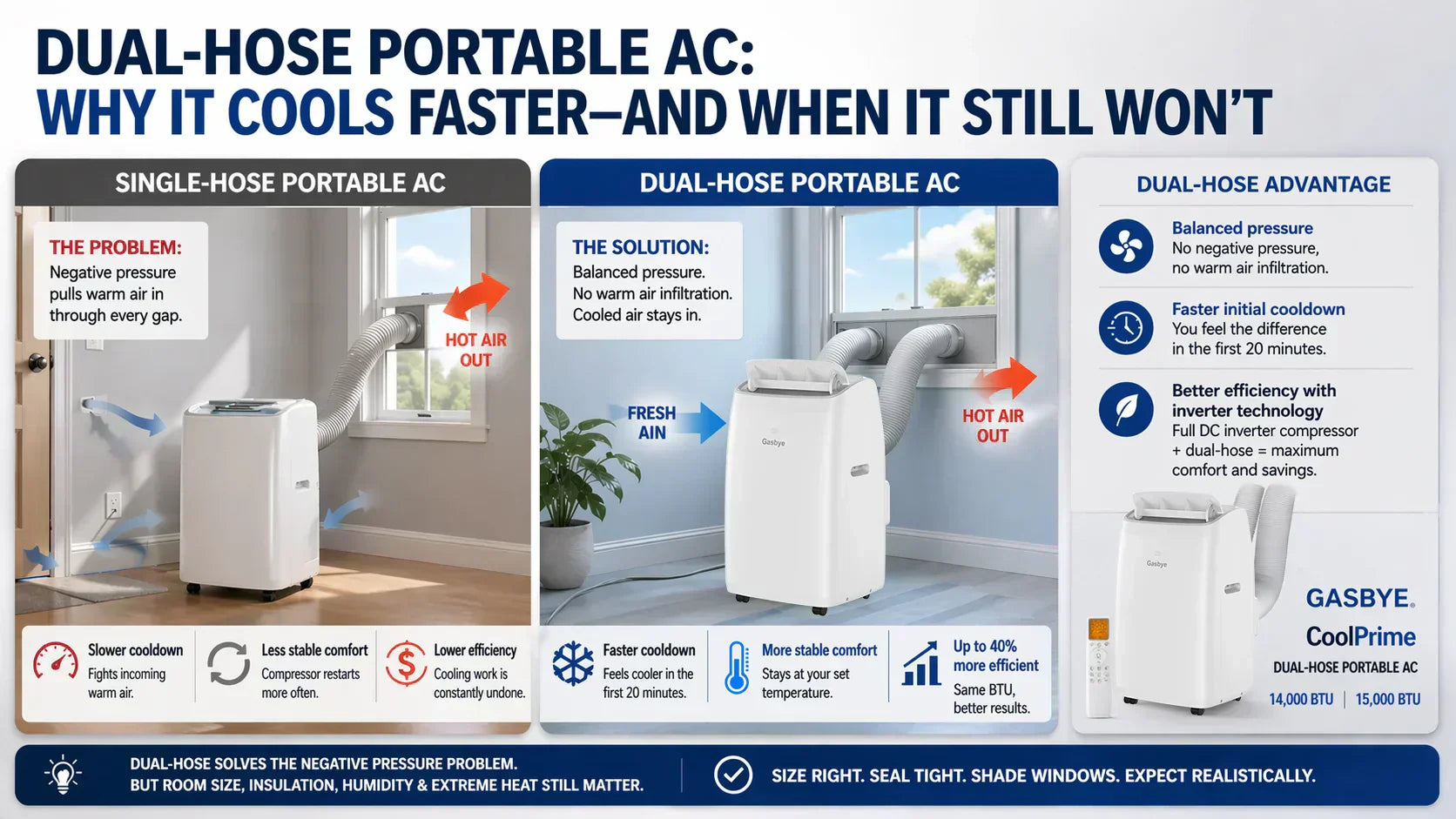
Every cubic foot of air exhausted outside has to be replaced by air from somewhere. Since the room is now slightly lower in pressure than the rest of the house, air gets pulled in through every gap it can find — door frames, window edges, recessed lights, electrical outlets. That replacement air comes from unconditioned spaces: hallways, attics, and adjacent rooms.
This is the negative pressure problem — the unit is effectively cooling with one hand and refilling the room with warm air with the other. It doesn't make single-hose ACs useless, but it limits how fast and how efficiently they can cool, especially in the first 20–30 minutes when the room temperature gap is largest.
How dual-hose fixes this
A dual-hose unit uses two separate ducts. One draws outdoor air into cool the internal compressor. The other exhausts that heat the air back outside.
Because the unit is no longer borrowing air from inside your room to cool its own components, indoor air pressure stays balanced. No vacuum. No replacement air sneaking in through gaps.
The result is straightforward: the cooled air the unit produces actually stays in the room and lowers the temperature, rather than partially compensating for warm air that keeps infiltrating. In practice, dual-hose units can be up to 40% more efficient than comparable single-hose models — not because the compressor is more powerful, but because the cooling work isn't being constantly undone.
You feel this most in the first 20 minutes. Single-hose units often seem slow to "take hold" of a room. A dual-hose unit with the same BTU rating will typically drop the room temperature noticeably faster in that initial window, and hold the target temperature more steadily afterward.
Gasbye's CoolPrime dual-hose portable ACs are built on this design — available in 14,000 BTU and 15,000 BTU.
The real-world advantage: what you actually feel
Three things change with a dual-hose design that you notice day-to-day.
Faster initial cooldown. The room reaches your set temperature more quickly because the unit isn't fighting incoming warm air from the rest of the house.
More stable comfort. Once the target temperature is reached, the compressor doesn't have to restart as frequently to compensate for warm infiltration. The room stays where you set it.
Better efficiency with inverter technology. A full DC inverter compressor — one that adjusts output up and down based on real-time room conditions, rather than running at fixed speed — works best when indoor conditions are stable. The dual-hose design gives it that stability. The two technologies reinforce each other in a way that single-hose units can't replicate.
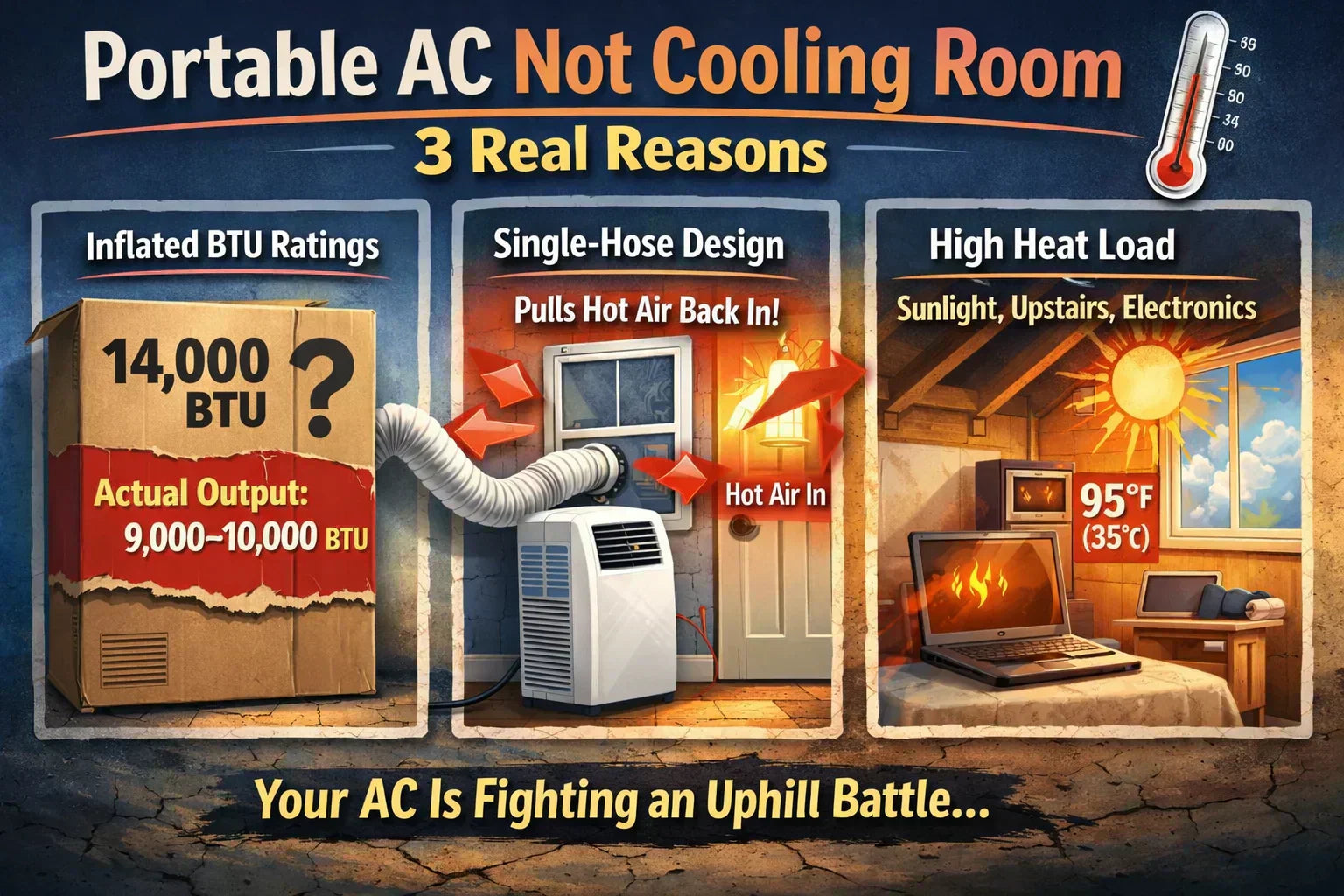
If your portable AC still isn't cooling well after switching to a dual-hose unit, the issue may run deeper. We covered the most common causes in detail here: Portable AC Not Cooling Room? What's Actually Causing It.
When dual-hose still won't keep up
This is the part most product pages skip. A dual-hose unit solves the negative pressure problem — but that's not the only thing that determines whether a portable AC can cool your room.
The room is too large for the unit's actual capacity. BTU ratings on portable ACs are not standardized the way most people assume. The ASHRAE 128 number (what most listings display) is measured at 80°F (27°C). The SACC rating — Seasonally Adjusted Cooling Capacity — uses higher temperatures and more realistic conditions, and is always lower. A unit listed at 14,000 BTU ASHRAE may deliver closer to 10,500 BTU SACC in real summer conditions. If you sized your room based on the ASHRAE number, you may be expecting more than the unit can deliver.
Poor insulation or no window covering. A room with single-pane windows and no blinds absorbs heat through the glass continuously. A dual-hose unit in that room is cooling against a constant radiant heat load — and no hose configuration fixes that.
Outdoor humidity above 85% RH. When outdoor air is extremely humid, the unit draws that heavy, moist air in to cool the compressor. High-humidity air is harder to work with than the drier, already-conditioned air inside your room. On the worst humidity days — a coastal heat wave, a tropical storm front passing through — a dual-hose unit can temporarily lose its efficiency edge over a single-hose.
Outdoor temperatures above 100°F (38°C). Every portable AC has to reject heat to the outdoors. When outdoor air is extremely hot, that process gets harder. This is a physics ceiling, not a design flaw — but it means even a well-designed dual-hose unit will struggle in extreme heat events.
Doors or windows left open. The dual-hose advantage depends on the room being reasonably sealed. If people are moving in and out constantly, air pressure equalization happens through the opening rather than being managed by the unit. The efficiency benefit largely disappears.
How to know if your room is a good fit
Before assuming a dual-hose unit will solve your cooling problem, run through this honestly.
Square footage vs. SACC rating, not ASHRAE. For a 400–500 sq. ft. room, you want at least 10,000–10,500 BTU SACC. Don't size based on the ASHRAE number.
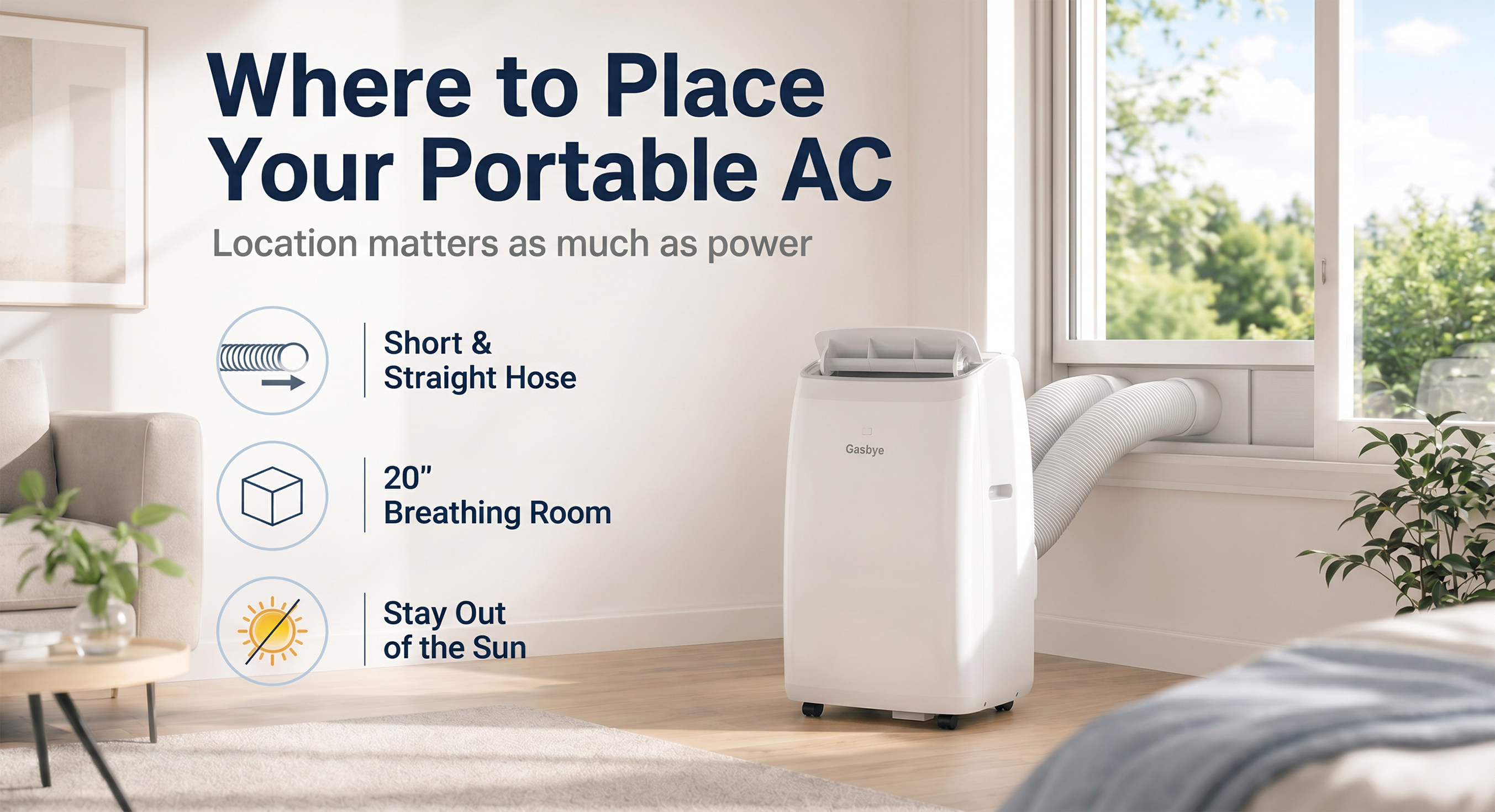
Window quality and sun exposure. West-facing rooms with unshaded windows gain significant heat through the glass in the afternoon. Add blackout curtains before upgrading your AC unit.
How sealed is the space? A bedroom with a door you keep closed is a better candidate than an open-plan living area connected to a kitchen and hallway.
Your local humidity pattern. In hot-dry climates — Phoenix, Las Vegas, inland California — dual-hose delivers its full advantage. In coastal or Gulf states where summer humidity regularly exceeds 80–85% RH, the advantage is real but smaller, and narrows further on the worst days.
FAQ
1. Does a dual-hose portable AC make more noise than a single-hose unit?
Not inherently. Noise depends mainly on compressor design and fan speed, not the number of hoses. Units with full DC inverter compressors typically operate at 45 dB or below in steady-state mode — within WHO guidelines for bedroom noise at night. The hose count alone doesn't change that.
2. How large a room can a 14,000 BTU dual-hose AC cool?
It depends on which 14,000 BTU you mean. Under ASHRAE 128 test conditions, 14,000 BTU corresponds to roughly 500–550 sq. ft. Under SACC — the more realistic standard — the same unit typically delivers around 10,500 BTU SACC, suitable for 400–500 sq. ft. When comparing units, always compare SACC ratings. Two units, both labeled "14,000 BTU ASHRAE," can have meaningfully different SACC numbers.
3. Is a dual-hose portable AC harder to install than a single-hose?
Slightly more involved, but not difficult. You're routing two hoses through the window kit instead of one. Most kits include adapters for standard double-hung windows and take 10–15 minutes to set up without tools. The one practical consideration: the dual-hose window kit is wider, so very narrow windows may need an extension panel.

Share:
Portable AC Not Cooling Room? What’s Actually Causing It
Where to Place a Portable AC for Maximum Cooling: The Ultimate Guide